

The Prenatal Multivitamin Conversation I Have With Every New Client as a Naturopathic Doctor Who Specializes in Fertility

Every new client who comes to me trying to conceive, newly pregnant, or planning to get pregnant within the next 6-12 months gets the same conversation with me.
“What prenatal are you currently taking?”
And while I work with a lot of women who tend to be on the crunchier side, every now and then I’ll run into the drugstore prenatal or what they think is a high quality prenatal like Ritual.

If I ask why they chose that prenatal, most of the time the answer is one of the following:
Their OBGYN recommended it
They were up late at night Googling one and it had the best reviews
Something affordable
Something they had quick access to (whatever they could find at Walmart or Walgreens)
As I write this article, my hopes are that this doesn’t come off as shameful or to make any new mother feel bad about their choices, but to educate. The prenatal multivitamin industry has done a fantastic job of making every bottle of prenatals look credible when in reality, most of them aren’t.
So, here is the conversation I wish every woman had before she chose her prenatal from a practitioner who spends her days looking at the downstream consequences of nutrient deficiency in pregnant and postpartum women.
What a Prenatal Multivitamin Actually Is
A prenatal multivitamin is a supplement but not a replacement for a nutrient-dense diet. I look at a prenatal as a way to help fill the gaps that diet alone (because hello we cannot ignore how depleted our soil is + food in general) cannot close. Pregnancy is one of the most nutritionally demanding states your body will ever experience, second to postpartum.
However, the problem is that many prenatals are designed to meet minimum standards rather than optimal ones, and this is where I become very picky.
What I Look for in a Prenatal
Here are the top four things I look at in a prenatal and how Needed covers all bases:
Form The form of a nutrient determines whether your body can actually use it. Most prenatals use scientific terms that sound great but in reality are very limited. The best example I can give is folic acid vs folate. Folic acid is a synthetic form of folate used in most conventional prenatals. If you have the MTHFR gene, this is a totally different conversation that I will likely get into in a different article but folic acid supplementation for you is ineffectively converted into the active form, methylfolate. Methylfolate bypasses the MTHFR conversion and is exactly what I want to see in a prenatal. The same principle applies across all of the B vitamins (B12, B6, B1, etc.).
Dose Many prenatals meet the RDA (Recommended Dietary Allowance) for each nutrient. However, this isn’t always optimal for every woman. An example here would be choline. Most prenatals don’t even have choline in them vs Needed’s new Prenatal Multi Gummy which has a whopping 55% of the daily value. If you’re consuming a nutrient dense diet, which most of my clients are, this allows you to more easily get to your goal of choline intake for the day.
ComplianceThe best prenatal in the world is the one a woman actually takes. First trimester nausea is real and impacts so many women to the point where they can’t get their prenatal down. The smell of a capsule, especially if it contains fish oil, can trigger nausea and vomiting in a woman with morning sickness. This is one of the reasons I love Needed’s new prenatal gummy. Most prenatal gummies are filled with sugar, an imbalance in mineral ratios, and synthetic dyes which can do more harm than good. Not all gummies are created equal and I’ll explain more on this below.
What’s Missing and WhyIron is probably the number one mineral that is absent from prenatals. This is intentional and in my opinion, the correct decision. Iron needs vary dramatically from woman to woman. A woman with low ferritin levels needs a very different dose of iron than a woman with normal iron stores. In the case of too much iron, this can cause gastrointestinal issues and impaired absorption of other minerals, amongst other uncomfortable symptoms. Iron should be routinely tested, dosed individually, and supplemented separately if needed. When I see a prenatal that doesn’t contain iron, I see a formulation decision that respects biochemical individuality and a brand who understands what it’s doing.
The Prenatal I Recommend Most Right Now
I have rotated through many prenatal recommendations throughout the years of being an ND. My recommendation changes when the evidence changes and when formulations improve.
Right now, the prenatal I recommend most consistently to my patients, especially those dealing with first trimester nausea, capsule compliance, and those who want a genuinely well-formulated option is Needed. Especially now that they have created a gummy, this is the best option for any woman who is struggling with morning sickness or getting multiple capsules down with breakfast.
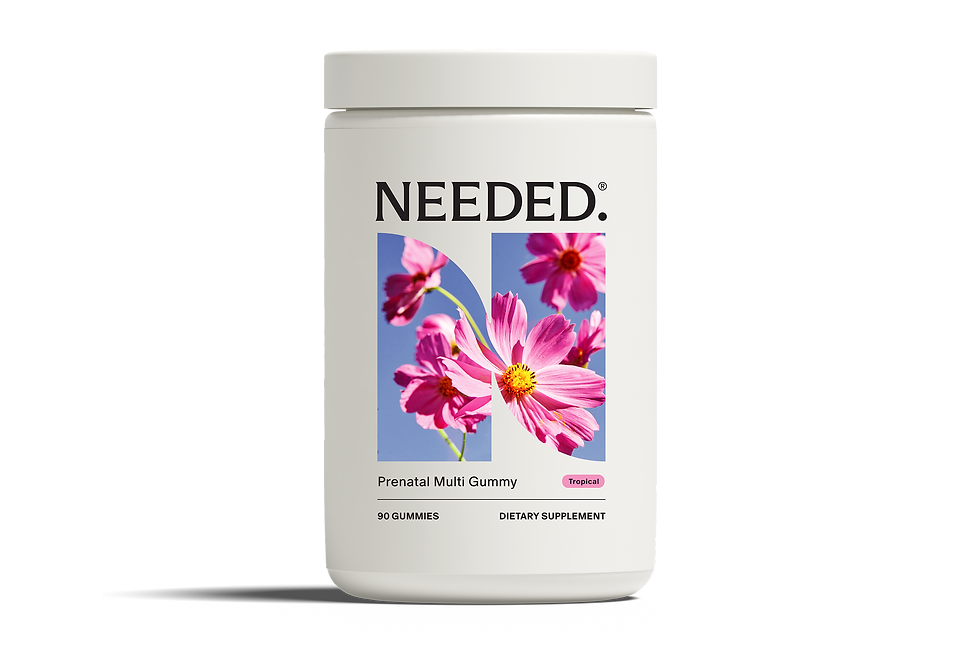
Previously, I was never a gummy prenatal person. The gummy format has historically been a marketing vehicle for inadequate nutrition dressed up in an easy delivery system. But, here’s how Needed’s Prenatal Gummy is different:
First, the Needed Prenatal Multi Gummy contains methylfolate, not folic acid. It also contains methylcobalamin, not cyanocobalamin. These forms are bioavailable. The doses are also meaningful. It delivers 4x more nutrition than the average of leading prenatals, including capsules‡. Which matters significantly when we are talking about the nutrition demands of pregnancy.

Second, for women who cannot tolerate capsules in the first trimester or who can’t swallow pills (hi that’s me), you aren’t compromising on quality or dosages, which makes this a fantastic option.
Third, for women who need an extra boost of choline (especially if you are like me and allergic to eggs), the gummy addresses the choline by giving you 55% of your daily value PLUS Needed has a Gummy + Choline bundle that offers 555mg of Choline.
Lastly, iron is not included in this formulation. For the reasons I described above, I always recommend to test iron individually before recommending supplementation. Low iron is common in pregnancy but always cross check with your provider.
The Bottom Line
Choose a prenatal with bioavailable forms
Choose one with meaningful doses
Choose one you will actually take consistently (you get the most out of your supplements when you take them every single day and are consistent, not just a couple times a week. The biggest issue I run into with my clients is getting down a capsule which is why the Needed gummy is a great option)
I also recommend lab testing throughout pregnancy as well. A few of my favorite, non-invasive labs for my pregnant clients include: The HTMA test, vaginal microbiome, and regular bloodwork to monitor iron, thyroid, and blood sugar levels.

You are growing a human being and your nutritional foundation matters more right now that it ever has or ever will.
‡4x more nutrition refers to the average amount of vitamins and minerals compared to the average of the leading prenatal brands as of May 2026. Brand A: 8x, Brand B: 4x, Brand C: 4x, Brand D: 4x.
This post is sponsored by Needed. All clinical opinions are my own.

Comments